Over the last decade, a new financial ecosystem has been developing alongside the traditional one.
It sits at the intersection of several powerful emerging technologies:
- blockchain infrastructure
- digital ownership systems
Together, these technologies are creating what many now refer to as the next layer of the internet — sometimes called Web3.
At the centre of that ecosystem sit digital assets such as Bitcoin and other cryptocurrencies.
But these assets are only one piece of a much bigger technological shift.
To understand why people are beginning to pay attention to this space, let’s run a simple thought experiment.
Many of the people who join CryptoGran are entrepreneurs or professionals.
So imagine this.
You have £1,000 to allocate.
Not life savings.
Just risk capital.
Where does it work hardest?
Many of us have taken this route.
You invest £1,000 into something like:
• branding
• a website
• marketing
• stock
• software
But the real investment is never the money.
It’s time.
A typical start-up requires:
- hundreds of hours in the first year
- thousands of hours before meaningful income
- years of persistence
Even successful businesses often take three to five years to reach consistent profitability. And many never scale beyond the founder.
Now don’t misunderstand me. Entrepreneurship can be extraordinary. Many of us have built fulfilling careers this way. But businesses have one unavoidable characteristic.
They are labour intensive and your income is often closely tied to your time.
- Now imagine placing that same £1,000 into a diversified basket of digital assets connected to emerging technologies.
No daily labour. No staff. No operations.
Just exposure to a fast-moving technology sector.
To understand why some investors are paying attention to this space, it helps to look at the previous market cycle between 2020 and 2021. During that period, several major digital assets experienced extraordinary growth as adoption accelerated.
Examples include:
- Bitcoin: roughly $7,000 → over $60,000
- Ethereum: roughly $130 → over $4,000
- Solana: under $1 → over $200
- Polygon: fractions of a penny → over $2
Now imagine a simple £1,000 portfolio spread across some of these projects.
If £250 had been placed into each asset at the start of the cycle, the approximate peak values would have looked like this:
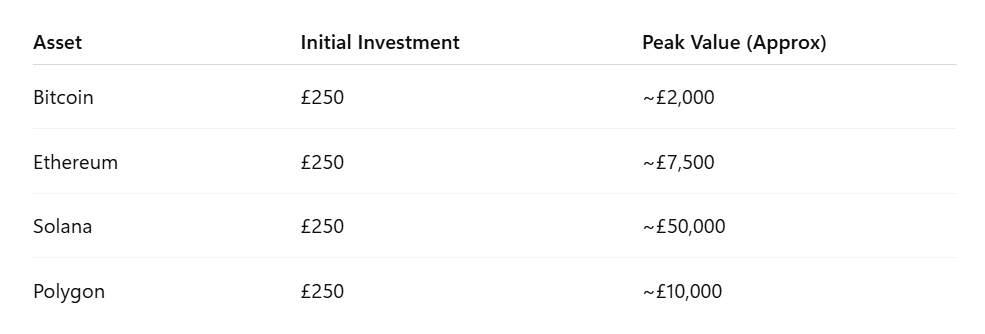
At the peak of the market cycle, that £1,000 portfolio could briefly have grown to more than £69,000. Of course markets move in cycles and values can fall sharply during downturns. But these numbers illustrate something important. Technology adoption cycles can compress enormous growth into relatively short periods of time.
This is where the comparison becomes interesting.
A business might require:
- thousands of hours
- years of effort
- constant operational energy
Whereas an investment in a rapidly emerging technology sector can grow without additional labour once the capital is deployed.
In other words:
One model requires time to create growth.
The other allows capital to capture growth already happening in the market.
This difference changes how many sophisticated investors think about portfolio strategy.
One of the strongest signals that something significant is happening in this space comes from institutional behaviour.
Large financial organisations rarely rush into new markets.
They study.
They build infrastructure.
They move quietly.
And that’s exactly what has been happening in recent years.
Major financial institutions are investing heavily in:
- blockchain infrastructure
- digital asset custody
- tokenisation platforms
- digital asset investment funds
They are not simply buying digital assets.
They are building the financial plumbing of an emerging technology ecosystem.
The global digital asset market is now worth over $2 trillion, and many analysts believe we are still early in the adoption curve.
So the question isn't:
“Should I gamble on crypto?”
That framing completely misses the point.
The smarter question is:
“Should some of my capital be exposed to emerging technology markets?”
Not instead of business.
Not instead of property.
But alongside them.
Because while businesses require time…
technology adoption can create exponential financial outcomes.
For many people the difficulty isn’t intelligence.
It’s complexity.
- Wallets.
- Security.
- Exchanges.
- Digital ownership.
Without guidance the ecosystem can feel confusing.
Which is why education makes such a difference.
When people understand the system properly, the whole space becomes far less intimidating.
And far more interesting.
Imagine this.
You take £1,000 of capital.
Not your pension.
Not the money that pays the bills.
Just a small amount you are willing to use to explore opportunity.
Now ask yourself two questions.
Where could that £1,000 grow the most over the next decade?
And perhaps more importantly…
Where will the next decade of economic growth actually come from?
If the next major wave of innovation is being driven by artificial intelligence, blockchain infrastructure, digital ownership and decentralised financial systems, then it may be worth understanding the ecosystem forming around those technologies.
History shows us something interesting.
The people who benefited most from previous technology waves were rarely the ones who arrived last.
They were the ones who took the time to understand what was happening early.
Not recklessly.
But curiously.
Not with hype.
But with education.
Because once you understand something properly…
you stop relying on headlines.
And you start making informed decisions about your own financial future.